YOUR CART
IS EMPTY
IS EMPTY

A dead battery is a common problem that car users like us often encounter, as most batteries have an average lifespan of about 2-3 years. When it's nearing or has passed this period, it's natural to feel anxious. So.. is your battery a dry or wet type, and how many years have you used it? >> Let's look at thewarning signs! below that... you need to change your battery now...
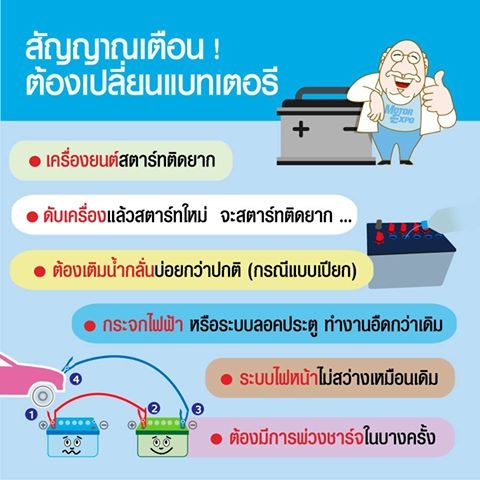
1. Difficult to start in the morning You can feel that the engine cranks as if it lacks power, or starts slowly before eventually firing up normally.
2. After turning off the engine and restarting immediately, or leaving it for a while and then starting, it will be difficult to start or exhibit the same symptoms as in the morning, meaning it cranks slowly before starting.
3. You feel that the power windows or door lock system operate more slowly than before.
4. Headlights dim when the air conditioner cycles on or off, or dim with the sound system (if an additional sound system is installed).
5. You have to add distilled water more often than usual (for wet-cell batteries).
6. Jump-starting is required occasionally. If such a case occurs, you must change the battery quickly to avoid your car not starting in a difficult-to-reach location for a mechanic, because driving the car to change the battery when it can still run is always better.
Because a battery is the main device for a car's electrical system, it stores power for various systems of the car. It's like a rechargeable flashlight battery. Its function is to store electricity for starting the engine and to store power when various electrical systems are used simultaneously. At certain times, the alternator might not be able to produce enough electricity, so the battery will feed electricity to various systems instead. Normally, after the engine starts, the battery works very little, because when the engine runs, the alternator works to produce electricity to feed various systems. At certain times when the engine's operating speed is unstable, and when various systems require a lot of electricity, the battery will feed power to the system instead. When the battery's charge decreases, the alternator will also supply current to the battery to keep it charged at all times. This cycle of operation continues as long as the engine is running.
The easiest solution when the battery runs out is to "jump-start" [Click to see how to jump-start a battery]


Follow Motor Expo Club Network