YOUR CART
IS EMPTY
IS EMPTY

Thailand is considered a country with continuous growth in the automotive industry, with relatively high annual demand for cars compared to its population, and is also an important automotive production base in the Asia-Pacific region. Moreover, due to a public transportation system that is still insufficient for consumer needs, many people want to own their first car. However, owning one car involves many other expenses besides car installment payments, fuel costs, and maintenance, which many people often forget. This leads to the question: What do you have to pay after buying a car?
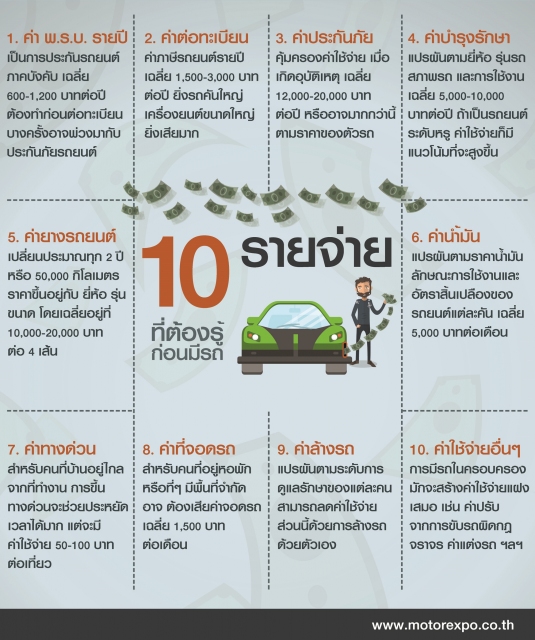
1. Annual Compulsory Motor Insurance (Por Ror Bor) Fee
Por Ror Bor is compulsory motor insurance under the Protection for Motor Accident Victims Act B.E. 2535. It costs an average of 600-1,200 Baht per year. Sometimes it's an expense bundled with car insurance, or sometimes it must be purchased separately.
2. Annual Vehicle Registration Fee
This is the annual vehicle tax, with an average cost of 1,500-3,000 Baht per year. The larger the car and engine size, the more expensive this tax becomes. For cars older than 7 years, they must also undergo an inspection.
3. Car Insurance Costs
Car insurance helps cover expenses arising from car-related incidents. Generally, there are options for Class 1-3 insurance, or it depends on each company's offer. Higher premiums provide greater coverage for your car. On average, it starts at around 6,500 Baht. For standard cars, Class 1 insurance averages 12,000-20,000 Baht per year. The more expensive the car, the higher the insurance premium.
4. Maintenance Costs
Cars naturally experience wear and tear and thus require maintenance. On average, every 6-12 months or 10,000 kilometers. Costs vary depending on the car's make, model, usage, and the owner's ability to care for the car. Even for ordinary cars, reasonable maintenance costs are typically 5,000-10,000 Baht per year. However, for more complex or older cars, maintenance costs can reach tens of thousands of Baht per year.
5. Tire Costs
Car tires are another very important component as they are the part that makes contact with the road. Worn-out tires can cause serious accidents. Therefore, it is crucial not to neglect changing tires at appropriate mileage and times. Generally, it is recommended to change them every 2 years or 50,000 kilometers, depending on usage conditions. Tire prices range from under 10,000 Baht per set to tens of thousands of Baht, depending on the model, brand, and size of the tires. But on average, a set costs 10,000-20,000 Baht.
6. Fuel Costs
Fuel costs are difficult to pinpoint precisely because fuel prices fluctuate constantly. Additionally, each person's usage may differ entirely. However, for those who use their car daily, fuel costs often exceed 3,000-5,000 Baht for a small car. For larger cars or those with high fuel consumption rates, fuel costs will be higher and could reach 10,000 Baht per month. Ways to reduce fuel costs include adjusting driving habits appropriately and planning your trips well.
7. Tollway Fees
For some people whose homes are far from work, using tollways might be unavoidable as they have to travel long distances and navigate daily traffic jams. Current tollway rates average 50-100 Baht per entry. For those who use tollways daily, monthly toll fees could reach 3,000-4,000 Baht.
8. Parking Fees
For people living in crowded dormitories, condominiums, or townhomes, or those who drive to work in business districts, renting a regular parking space for 1,500-5,000 Baht per month becomes unavoidable. This is especially true for private cars with more than 7 seats, for which the Department of Land Transport recently issued new registration regulations stating that they must have parking under clearly defined conditions.
9. Car Washing Costs
Car washing costs can amount to several thousand Baht per month. A way to reduce this expense is to start washing your car yourself, which not only helps save a lot of money but also allows you to choose the equipment and cleaning solutions you want for your car.
10. Other Expenses
In addition to all the expenses mentioned above, there may be other hidden costs that could arise unexpectedly, such as fines for traffic violations, car modification expenses, and costs for various car accessories, which are not included in this list.
With this in mind, prospective car buyers should study the information about upcoming expenses beyond the monthly car installment payments, and calculate their income and expenses thoroughly to determine if they can afford a car.


Follow Motor Expo Club Network