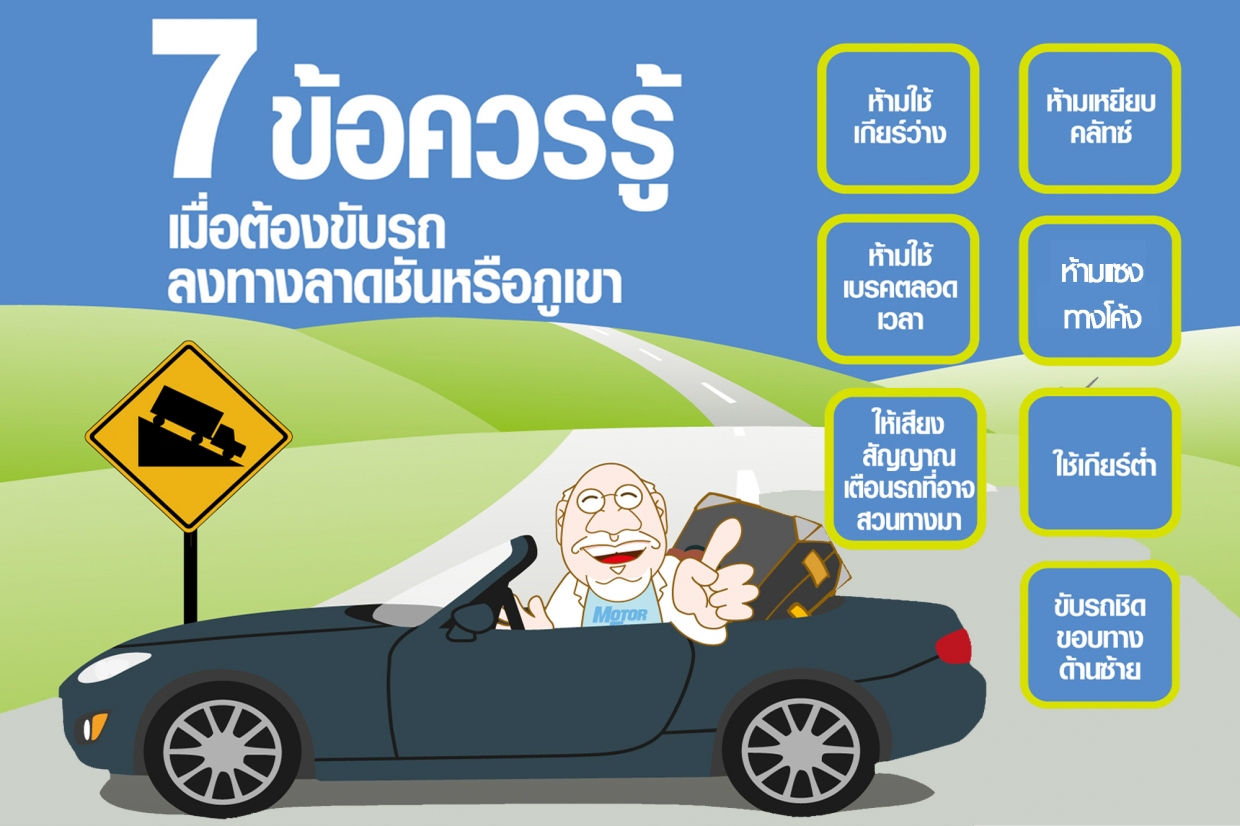
How should a driver act when descending a steep slope or mountain?
Dec 28 , 2017อ่านแล้ว 41,731 ครั้ง
During the long holiday season, many people likely have plans to return to their hometowns or travel for leisure to various places, especially in the North or other regions with numerous mountains. Driving routes will include both mountains and steep slopes. Some people may not be familiar with or have experience on such routes. But no matter where you go, the most important thing is to prepare your vehicle and study the route well before traveling. It is also important to thoroughly learn driving techniques, because most routes are uphill and downhill. Therefore, it is very necessary for us to know what to do. If you are not skilled on the route, danger can strike at any time. Let's see..."How should a driver act when descending a steep slope or mountain?"
1. Do Not Use Neutral Gear
When driving down a steep slope or mountain, “do not” put the car in neutral and let it rollunder any circumstances, as this will cause you to lose control. Since the car is very heavy, if the driver lets the car roll in neutral, it will accelerate downhill increasingly due to gravity, which can be dangerous. It is best to use engine braking to assist in braking by downshifting one gear at a time as appropriate, ensuring the gear change is proportional to the speed. This will result in higher engine RPMs but rapidly decrease the car's speed, helping to maintain control.
2. Do Not Press the Clutch
The clutch connects the engine's traction through the gears to the car's wheels. Therefore, while the car is moving and in gear, the engine's traction transmits power to press against the wheels. If the car is moving and you press the clutch, the engine's grip on the road will be cut off. The car will lose traction. Especially if the road is slippery or there's a turn, the car will immediately lose balance and spin. Therefore, for those accustomed to braking by also pressing the clutch, this makes the car accelerate forward faster because the engine's traction is cut off, making braking and steering more difficult. Try practicingpressing the clutch only when shifting gears or driving slowly. ***Never rest your foot, whether lightly or heavily, on the clutch,because if you do, you might accidentally press it out of habit.***
3. Do Not Use the Brakes Constantly
When driving downhill or on a steep slope, tap the brakes intermittently and use a low gear to assist. Do not use the brakes constantly, because excessive or prolonged braking will cause the brakes to overheat, the brake pads may burn out, and the brakes may fail. This point should be strongly emphasized, as it can lead to life-threatening accidents. It is best to tap the brakes only when necessary, and you should check the car's brakes before traveling to ensure they are safe and ready for use.
4. Do Not Overtake on Bends
Especially on blind bends where you cannot see oncoming vehicles, drive slowly and cautiously. "Look far ahead" to initially assess the road. Once it's safe and you've passed the bend, then find an opportune moment to overtake.
5. Use Low Gear
Using a low gear when going uphill or downhill on a steep slope helps provide power to confidently climb hills and resists the car from rolling down too quickly and losing control.
6. Drive Close to the Left Edge of the Road
Drive on the left side of the road, and consider the center of the road or the dividing line/lane as the primary guide.
7. Should Give Warning Signals to Oncoming Vehicles
Especially on blind bends where visibility is restricted, you should give a warning signal to oncoming vehicles.
Driving routes can include mountains or steep slopes. Some people may not be familiar with or have experience on such routes. But no matter where you go, the most important thing is to prepare your vehicle and study the route well before traveling. It is also important to thoroughly learn driving techniques.