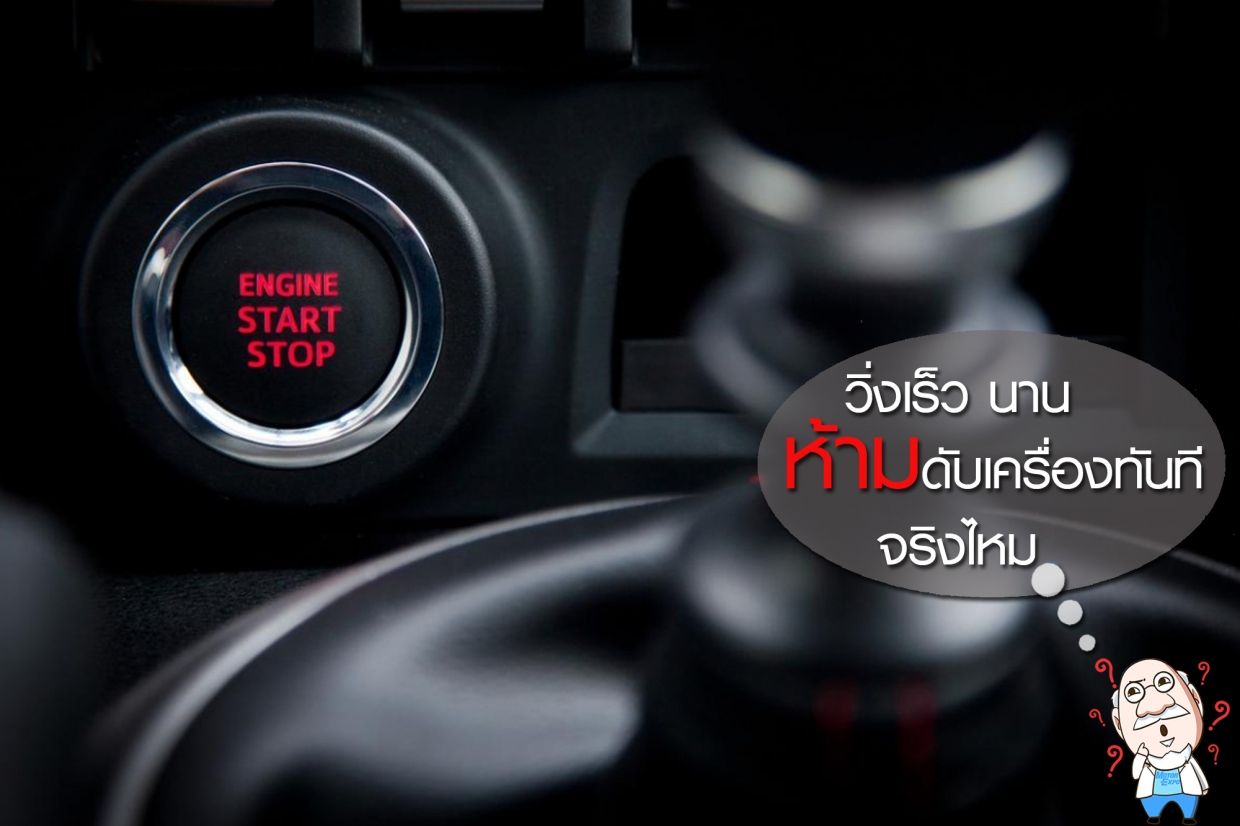
Drive fast, for a long time, do not turn off the engine immediately...Is that true?
Apr 5 , 2017อ่านแล้ว 124,658 ครั้ง
Non-turbocharged engines, no matter how high the RPM or how long they run, can be turned off immediately because their cooling systems are already complete. There is no need to "wait" like turbocharged engines.
While traveling upcountry, at roadside service stations, you often see many pickup trucks parked without turning off their engines. I once asked a driver and got answers like "The engine is hot, can't turn it off immediately. Must warm it up first." "Why turn it off? We're leaving soon. Frequent starting wastes fuel." The worst was "Can't turn it off. It might not start later." ?!? How many people truly know why?
Most pickup trucks use almost entirely diesel turbocharged engines because they provide good torque, suitable for hauling. If driving fast, the turbo works almost continuously. Upon reaching the destination, the engine should not be turned off immediately, not because the engine is hot, but because the turbo is hot (very hot) instead. As for wasting fuel and not starting, I don't think they are related.
The sole reason for this lies in the "turbo" or the forced induction system itself. A turbo's function is to compress more air into the combustion chamber to increase engine power by reusing part of the exhaust gases from the engine. Whenever the engine is revved at high RPMs for extended periods, the exhaust housing on the outlet side becomes extremely hot (if viewed at night, it would appear reddish). Engineers therefore designed a system where a portion of the engine oil circulates to the turbo shaft to lubricate and cool it. In some car models, water from the radiator may also be used to assist in cooling (but most cars do not have this).
Imagine this: if we turn off the engine immediately, the heat accumulated in the turbo will be so high that the engine oil remaining in the turbo shaft can burn, because the system is no longer circulating due to the engine being off. This way, the turbo can suffer significant damage.
However, if we don't turn off the engine immediately, but let it idle for about 3-5 minutes (depending on its cooling capacity), waiting for the turbo's temperature to drop before turning it off, no damage will occur. Or, if it's truly necessary to turn off the engine and you know you'll arrive in about 5-10 minutes, reduce your speed and use the highest gear at a constant speed of about 60-80 km/h. Upon reaching the destination, the turbo will have cooled down, and the engine can then be turned off immediately.
For non-turbocharged engines, no matter how high the RPM or how long they run, they can be turned off immediately because their various cooling systems are already perfect. So, anyone who knows their car doesn't have a turbo can turn off the engine immediately, anywhere, anytime. As for cars with turbos, if driven normally and not too aggressively, they can also be turned off immediately.
They say... : Driving fast for long distances "don't" turn off the engine immediately...Is that true? True and not true : True! For turbocharged cars, and not true! For non-turbo (NA) cars.